ASTRONOMY TOURS

GALAXY GAZER TOUR
(1-1½ hour duration)
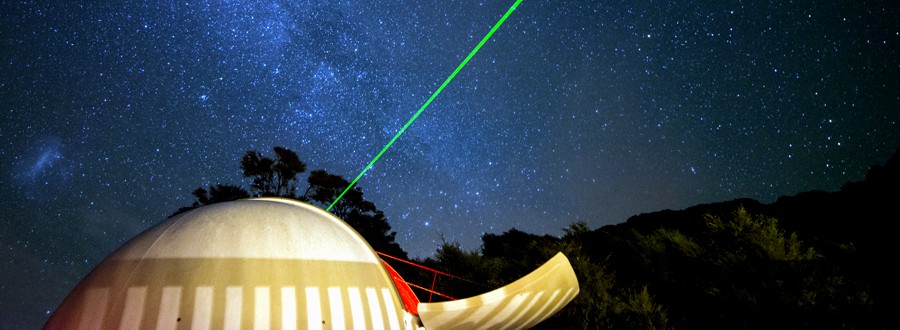
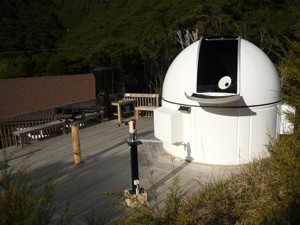
This provides a comprehensive introduction to our beautiful southern night sky. Commencing on the spacious elevated observation deck you will learn to recognise several constellations with our green laser pointer and how the stars and planets move using the walk-in Pipehenge observing frame.
You will then move on to the professional 14" Celestron CGE Pro 1400XLT telescope in the rotating dome to view a range of objects including the moon, stars, planets and galaxies depending on availability on the night of your visit. Children can operate the dome rotation to give us a clear view of the sky.
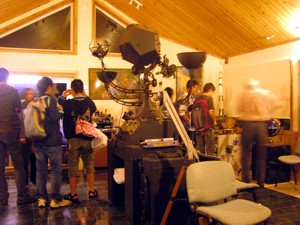
Back in the study you can examine and learn about the history of our classic Spitz A2 planetarium projector undergoing restoration and how it is used and then handle a 4½ billion year old meteorite. There will be plenty of time for questions and discussions about things astronomical and geological.
A hot drink is provided to ward off the evening chill and a detailed information pack including a sundial kit is supplied to enable you to further your astronomy interests at home.
Rates
$80 / Adult, $40 / Child (under 17 years)
$200 / Family (2 Adults, 2 Children)
Minimum tour size is 2 adults.
TO BOOK PLEASE PHONE
0064 7 866 5343
Saturn Jupiter & Io
Observation Deck
Planetarium Room
Tour Highlights
Depending on the season and sky conditions you will be shown a selection of some of the following celestial treats:
STARS AND CONSTELLATIONS
- You will learn about the MILKY WAY, our very own galaxy and our position in it. The brighter CONSTELLATIONS will be identified and you will learn how to trace out some of their shapes so they become familiar signposts in the sky, wherever you are.
- If the SOUTHERN CROSS is high in the sky you will learn how to use it to find South, and maybe even how to tell the time! You will see the COALSACK, a beautiful dark nebula and the JEWEL BOX star cluster nestled in the Cross.
- ALPHA CENTAURI, our nearest star (apart form the Sun of course), will be pointed out and you will be able to discover for yourself it's surprising secret when you see it in the telescopes.
GALAXIES
- The beautiful MAGELLANIC CLOUDS, our twin neighbouring galaxies, will be shown and you will learn about the exciting event that took place there in 1987 and see the stunning TARANTULA NEBULA and world famous ETA CARINA NEBULA.
- The famous and beautiful ANDROMEDA GALAXY may be visible low in the northern sky. This is the nearest galaxy to us having a spiral shape similar to our own MILKY WAY galaxy.
- The famous southern hemisphere GLOBULAR CLUSTERS , OMEGA CENTAURI and 47 TUCANI , will be identified and you will learn about their unusual history and what the MILKY WAY did to them!
- Beautiful OPEN CLUSTERS include the famous PLEIADES (Seven Sisters, or Matariki in Maori Folklore), the HYADES and the JEWEL BOX, noted above.
PLANETS
The planets that are visible in the evening sky are constantly changing so it may not be possible to see any on some nights. Call for details.
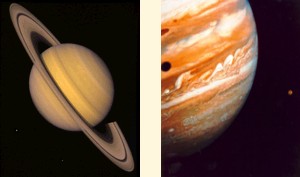
- JUPITER is a stunning sight in binoculars and telescopes. You will be able to see 3 or 4 of it's largest moons and identify some of it's cloud bands. We may even be able to see some of the moons move or disappear during the course of your visit. If we're very lucky the GREAT RED SPOT may also be visible on Jupiter's face.
- SATURN with it's beautiful rings is a wonderful sight although the rings are very narrow this year as we are looking at them almost edge on.
- MARS is well worth a look as well, as is VENUS. However, some of the planets are only visible in the early morning at present and so will probably not be visible during the evening tours for a few months. If either planet is a special passion it is possible that a special early morning (or very late night) tour could be arranged although additional charges may apply.
THE MOON AND SUN
- The MOON is a wonderful sight in all our binoculars and telescopes, with sights ranging from it's huge craters to it's majestic mountains and wrinkled lava flows.
- The SUN, our nearest star with it's occasional spots and flares, is a spectacular sight through our dedicated solar telescopes. If there is sufficient interest a special daytime tour can be arranged…call for details.